
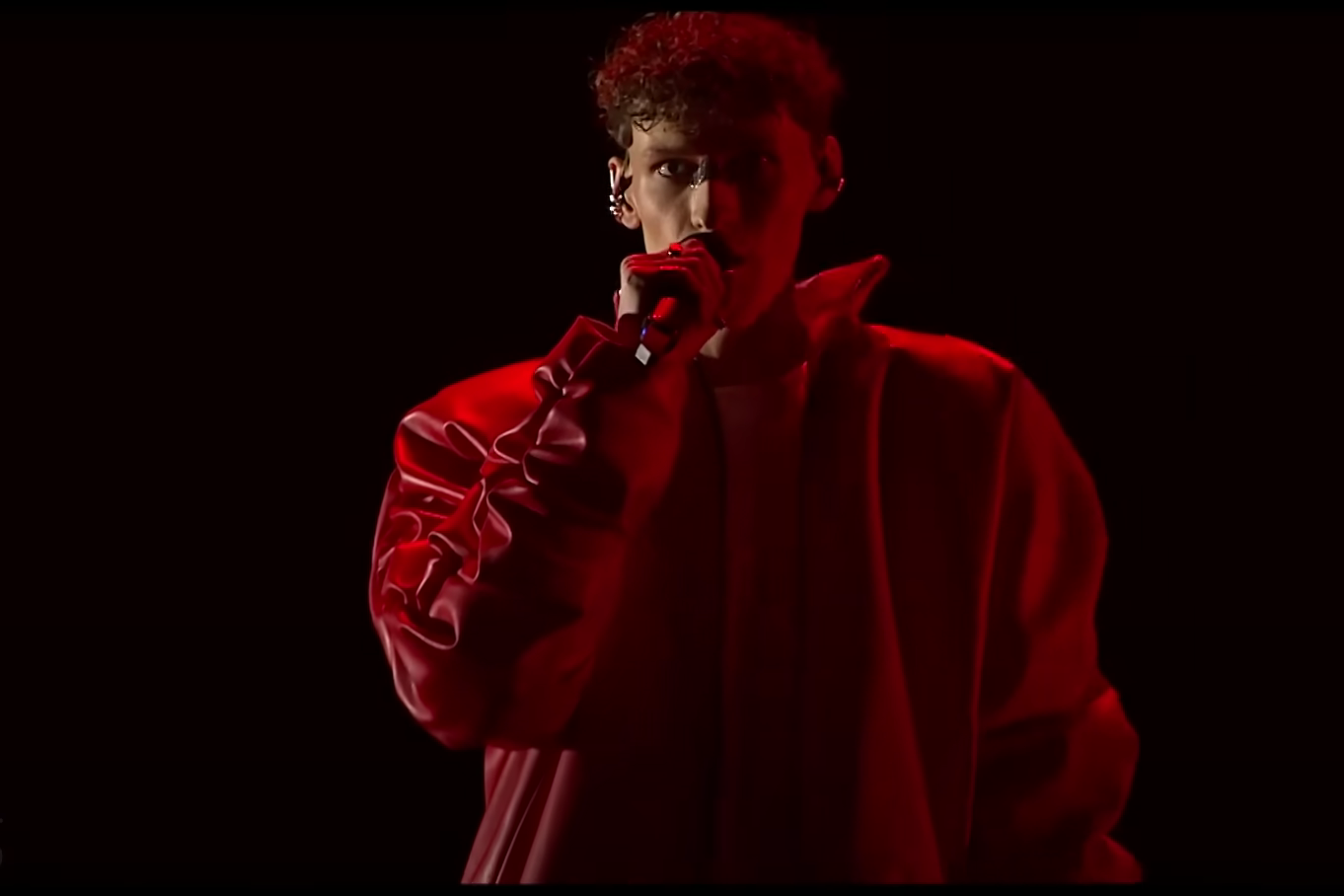
With my critic’s hat on, I can point to many songs which are worthy winners of Eurovision 2024 for doing two things: being absolute bangers AND reflecting the zeitgeist. Joost Klein’s Europapa has a staunchly pro-Europe bent at a time when right-wing nationalist forces across the continent are fighting the ideals of free movement. Nebulossa’s Zorra sparked a feminist debate in Spain, but also raised important questions around ageism and the invisibility of older women. And Nemo’s The Code is a maximalist tour de force that deftly translates the concept of being nonbinary in a way that millions can easily understand.
But with my fan hat on, there is one song that has remained firmly – and pleasurably – lodged in my brain since I heard it in January – Luktelk, by Lithuania’s Silvester Belt.
Silvester Belt studied Commercial Music Performance at the University of Westminster, and I feel like this performance means he should be getting an honorary PhD. Because he clearly learned SOMETHING, since this is 2 minutes and 41 seconds of a top-notch pop performance.
A quick summary, since Luktelk is performed in Lithuanian: Its title translates in English to ‘Wait Up’ or ‘Hang On,’ and its lyrics describe a dreamlike state. Silvester references tonight and tomorrow and the passage of days, but time seems to pass differently here. The most urgent thing is that the person he is with stays by his side in what may be an endless night.
Let me break down the components of what make Luktelk great:
- Production – I am on the record as liking my bleeps and bloops, but nothing – NOTHING – hits my sonic nerve as hard as the ‘whomp whomps’ in the chorus of this song. Whenever they come on, my body has a Pavlovian response where I pump my fist in the air in sheer joy. (This is not always a good thing; I have listened to Luktelk on the Tube, at the office, in bed on my headphones next to a person who is sleeping. None of these locations are conducive to a good body-shaking fist pump.)
- Staging – Fans of Lithuanian music know Gabrielius Vagelis, the long-legged pop star who married amazing songs with disastrous costume and dance choices. Silvester Belt is like an evolved Gabrielius Vagelis. His costumes are eye-catching, but fall on the side of fashionable rather than ridiculous. His dance moves are choreographed, but still something that fans can emulate at home. And while giant projections of one’s face usually detract from the performance, here they add to the surreal, dreamlike quality of the whole song.
- Lyrics – A current trend among Eurovision songs is to add wholly unnecessary dance breaks, just for the purpose of showing off the dancing chops of the performer (usually a pop girlie). But this song is clever enough to justify its dance break in its lyrics:
Look, I realize that musical taste is subjective, and what appeals to one person will not appeal to others. But then I hear a song like Luktelk, and I wonder how the producers have managed to crack the code to writing the perfect pop song. It lights up all the dopamine centres of my brain. I have listened to this song about 342 times since it was released, and will listen to it another 142 times before Eurovision begins.
Luktelk will not win Eurovision. It is merely a diamond of a song without a compelling backstory. Silvester Belt is all charm, but a polite young man with a nose cuff and wide pant legs is hard to cut through the noise of all the Weird Little Dudes* who are petting cats and running around with Duolingo and generally eating up the airtime pre-contest. But I don’t care if Luktelk wins – it exists, and will continue to exist, and will be a song that I can listen to and watch and vote for in the Eurovision 250 countdown and flail along to when it comes on at Euroclub, and that is enough. Thank you, Silvester Belt, for putting every single lesson from the University of Westminster to very, very good use here.
*credit to the Eurowhat Podcast
 dudepoints.fun