
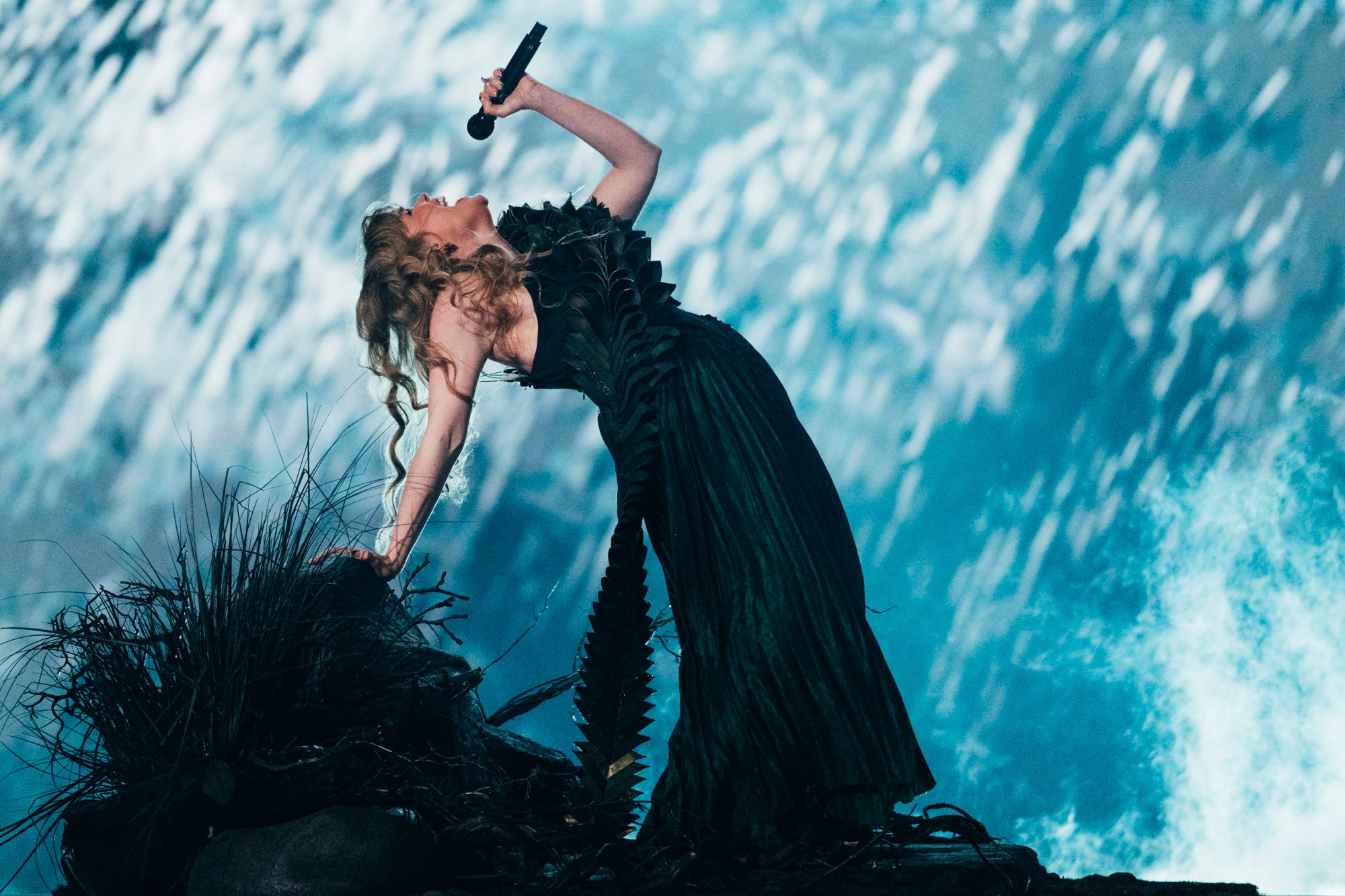
You know, it’s been two months since Eurovision 2024, and when I think about this year’s contest, I still feel like Gunnhild pictured above – screaming into the void wanting to bring the gods down to just fix everything. (And thanks, Sarah Louise Bennett, for capturing this moment.)
Earlier this month, the EBU announced “future development areas” for the contest following the independent review into the event. I’m hoping to spend the next few posts doing some analysis into these areas and what might be behind the anodyne PR speak that is in the statement. I also want to talk about some of the follow-up press statements that have been made by members of the organisation – namely, Jean Philip de Tender and Martin Osterdahl.
But first, let’s talk about the Independent Review. The EBU Press Release states:
The independent review, led by an independent industry expert, gathered extensive feedback about this year’s event from a broad range of ESC stakeholders, including Heads of Delegation, members of the ESC Reference Group (RG), the Contest’s governing board, as well as the EBU/ESC core team.
There are two points I’d like to raise about this report.
First, I think the EBU and I might have separate definitions of “independent industry experts.” The report was written by Pernilla Gaardbo, who was the Executive Producer of Eurovision 2014 – the same role held by Martin Osterdahl for the 2013 contest. I understand that 2014 was a decade ago, which is a long time in Eurovision world – Belarus, Russia and Montenegro were still participating.
Having spent my entire career in public sector organisations, I understand that, for after-action reviews, it can be seen as helpful if the reviewer has some degree of familiarity with an existing bureaucracy, so that the review is not tied up with an ongoing explanation of what the organisation is and how it operates.
However, this is Eurovision, a song contest. It is not a review of a top secret programme that may necessitate the use of someone with existing familiarity and a security clearance. Yes, the governance structure relies on a reference group made up of representative of broadcasters from multiple countries. But that’s not so complicated. It’s nothing that can’t be covered in a morning briefing. I bet a Eurovision YouTuber has already covered the topic quite succinctly.
A truly independent review would have relied not on a single person with existing ties to Eurovision and the EBU, but on a panel of experts from television production, event management, human resources, and organisational development. There are a number of consulting firms that make a healthy living providing exactly these types of services.
The second point that I find telling about the report is the broad range of stakeholders that were consulted. Fifty people sounds like a lot of people to interview, but when you look at who was interviewed, the vast majority of them are people who were involved in producing the show – the reference group and the contest’s core team. These are the people who have the most to lose from a negative review. I would be interested to know how the independent reviewer balanced the need for honesty, impartiality and self-reflection with the human desire to protect one’s job. (The option for anonymity was apparently granted to interviewees.)
Heads of Delegation, who represent their host broadcaster, rather than the EBU or the contest, were interviewed as part of the review. Their inclusion is welcome, considering the spate of complaints that emerged in Malmo, but these interviews are not a substitute for a resolution of complaints.
Finally, the group that is missing from this list is artists. I understand that Heads of Delegations are supposed to represent all the issues associated with a specific country. I do not want to minimize their important role in building a country’s participation in Eurovision year after year, and creating a supportive environment for artists to perform. But they cannot represent the views of the person who is the face of the country for a given year, and is receiving the praise, criticism, and pressure on that stage.
In Sweden, we saw multiple artists in tears over the situation backstage. Other artists – including seasoned professionals like Gate, who have been performing for nearly 25 years – considered dropping out. It was only after crisis talks were held that the situation was resolved at the last minute. I do not know if their experiences can be reflected by a Head of Delegation, especially one that is going to need to deal with the EBU at future Eurovisions.
When the winner of Eurovision notes that the organisation “needs fixing a little bit” at their winner’s press conference, perhaps the independent investigator might want to talk to them – a person who should have had the best week ever – to find out more?
 dudepoints.fun