
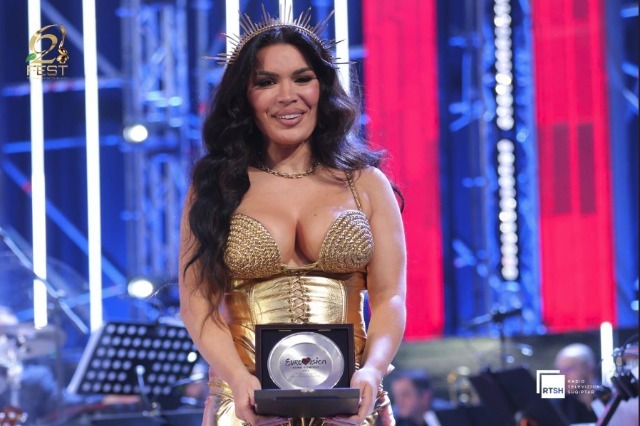
While I know it seems like I obsess over the subtext of Eurovision, I actually do watch this contest to unwind. And I was looking forward to Albania’s Festival I Kenges, which reliably delivers dramatic songs, many electric guitar solos, and women wearing fashions carefully engineered to show off a maximum decolletage while still remaining secure in the Albanian performing environment. A prime example of this is last year’s winner, Besa:
And for the most part, I really enjoyed this year’s contest! Artistic director and Eurovision alum Elhaida Dani programmed a selection of songs from a variety of genres. She was clearly influenced by Sanremo – down to the stairs of death – and that’s not a bad thing. We had dance break pop, divorced dad rock, emotional sad bois, rousing empowerment, and ethno electropop. It was a solid National Final, with ad breaks long enough to make decent snacks.
Going into FiK, many were excited about two returning contestants in particular – Mal Retkoceri, who won FiK62 (but did not win the vote to go to Eurovision) and Elvana Gjata, who was runner up in FiK58.
Let’s be honest – both of their songs for FiK63 were not a patch on their previous entries. Mal’s Antihero was a repetitive pop punk song that lacked the build and power of Cmendur (and NO I am not talking about his arms). Elvana’s Karnaval, on the other hand, was a generic Latin-infused dance track written by committee (indeed, the people behind Roxen’s Eurovision entries). It doesn’t compare to Me Tana, a song written by Gjata herself that manages to be a banger without losing any of its Albanian flair.
But what annoyed me so much was not the quality of the songs – it was the way that both of the artists approached them. Here’s Mal’s semi-final performance of Antihero:
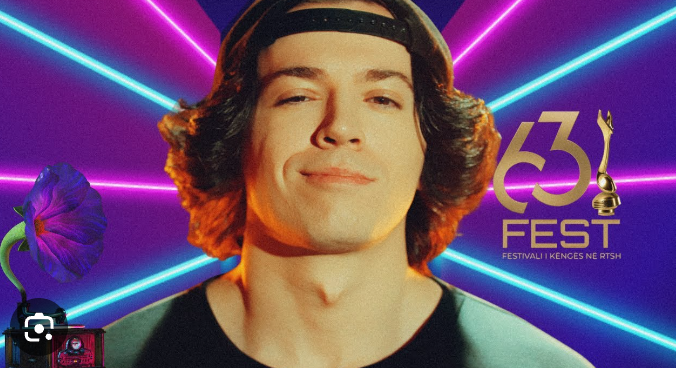
At first, it’s promising. Mal’s in a costume, dressed like Gerard Way and Harley Quinn and clearly channelling angsty references familiar to anyone who lived through the early-2000s emo heyday. He even winks at the camera.
But then…that’s it. Less than a minute into the song, we’ve seen all his tricks – the miming of the electric guitar, the extension of the arms, the strutting around the stage. And the performance becomes the worst thing possible on a Eurovision stage – boring. Mal seems to know this, because at points, he seems to shrink into himself, singing down to the floor of the stage, as if the lyrics were imprinted there.
Elvana, on the other hand….
Elvana is throwing everything she has at this song. She’s coming down from the ceiling. She’s got her best Dua Lipa moves ready in a completely unnecessary dance break. She’s USING PEOPLE AS A HUMAN STAIRCASE. The woman is being lifted and twirled and elevated on a surprise plinth. We barely have a chance to realise what is going on before Elvana’s moved to another element of the performance. Elvana’s song is not good, but that doesn’t mean her performance isn’t FANTASTIC.
And before the results came in, I was really angry about the disparity in these performances and what it says about gendered expectations in our society. Both of these artists were front runners; both of these artists knew where they’d be competing. So what did Mal do? He wore a costume and thought that was enough – that the mere effort of dressing up was equivalent to staging. The sheer presence of his masculine self could enable him to swagger and charm his way through a three-minute performance – no other preparation necessary.
In Mal’s defense, that is kind of what worked for him last year. The one variable that changed was his outfit. Here’s a blurry capture of a moment during Mal’s performance of Cmendur:
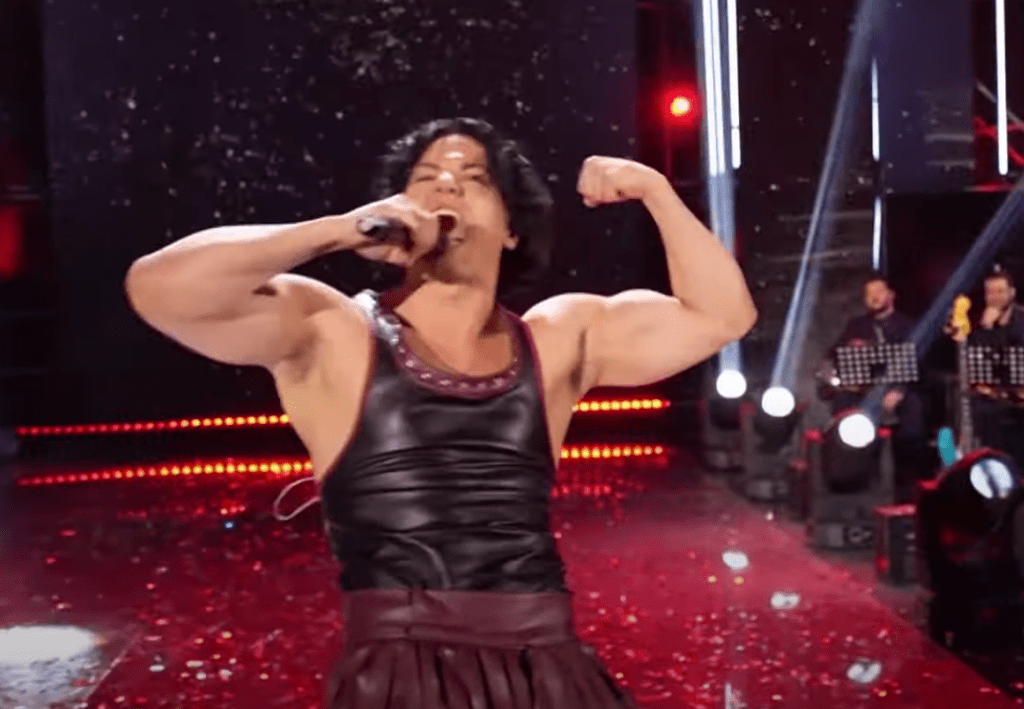
Which makes for an interesting contrast – when Mal performs masculinity fully clothed, he doesn’t quite succeed as much as when he performs masculinity as an object to be admired. Mal’s arms are as carefully constructed as any of the bodices of the female contestants. Mal’s public persona – the backwards baseball cap, the Instagram posts about grinding at the gym, that SMIRK – seem to all point to a bro just doing his thing. Was Antihero Mal’s cri de couer about the strictures of this type of masculinity, where all he’s prized for is bellowing into a microphone while flexing? Antihero seems written as a way to show range beyond Mal’s Chad status – but the only problem is that Mal relies so much upon his standard male persona that he hasn’t developed other skills to compensate. And thus, we’re left with the impression that he’s just bullshitting his way through the song because a costume is enough.
Elvana, on the other hand, is a perfect example of the stereotype of the uber-prepared woman. She didn’t win FiK58, so she came back this time with a checklist of things that would make the perfect Eurovision package – songwriters with a track record in the competition; a dance break (representing a new trend); a Eurovision-friendly song, and a whole bag of choreographic tricks. There were people who brought staging to FiK63, but I don’t think anyone worked as hard on their staging as Elvana. She took her failure and learned from it and did everything that everyone expected from her. And what makes me so angry is that the level of effort that she put in was obviously so, so much higher than Mal, and yet, the two of them were there as competitors in the final, as if their songs were equal.
The results, thankfully, lessened my anger. I was dreading a scenario where there would be an under-prepared man beating the clearly competent and better qualified woman, just because that’s been happening all my life. But the juries and voters of Albania rewarded Elvana for her effort while still recognizing that her song was, sadly, pretty mid. I hope Elvana enters again, just with a song that she’s written herself.
As for Mal? Well, post-results, I feel kind of bad for him, because he, too, is trapped in a prison of gendered expectations. All his work writing and producing Antihero and yet his performance has come down to one thing that isn’t even in the song – his arms. Many of the comments I saw during FiK relating to Mal were all a variation of the same thing – when he was going to get his guns out. He’s being objectified just as much as all the women in super-tight dresses, with the difference being that he hasn’t spent much of his life also being conditioned on how to deal with and use that objectification to get what one wants. Maybe if someone told Mal he could spend less time in the gym and more time exploring his Antihero side, he may be able to showcase a more engaging persona on stage.
 dudepoints.fun
1 Comment