
Thirty (30!!!) years ago, Poland sent a limber-voiced 22-year old named Justyna Steczkowska to Eurovision with the song Sama, which translates to “Alone” in English. It’s a sweet little song about how insignificant she feels at times. Steckzkowska, dressed in a long silken robe, has no choreography aside from a few hand motions. Rather, the power of her performance comes from her impressive high notes. It’s a chill vibe, like a Warsaw jazz club singer suddenly possessed by the need to do a big finish. You can see it here:
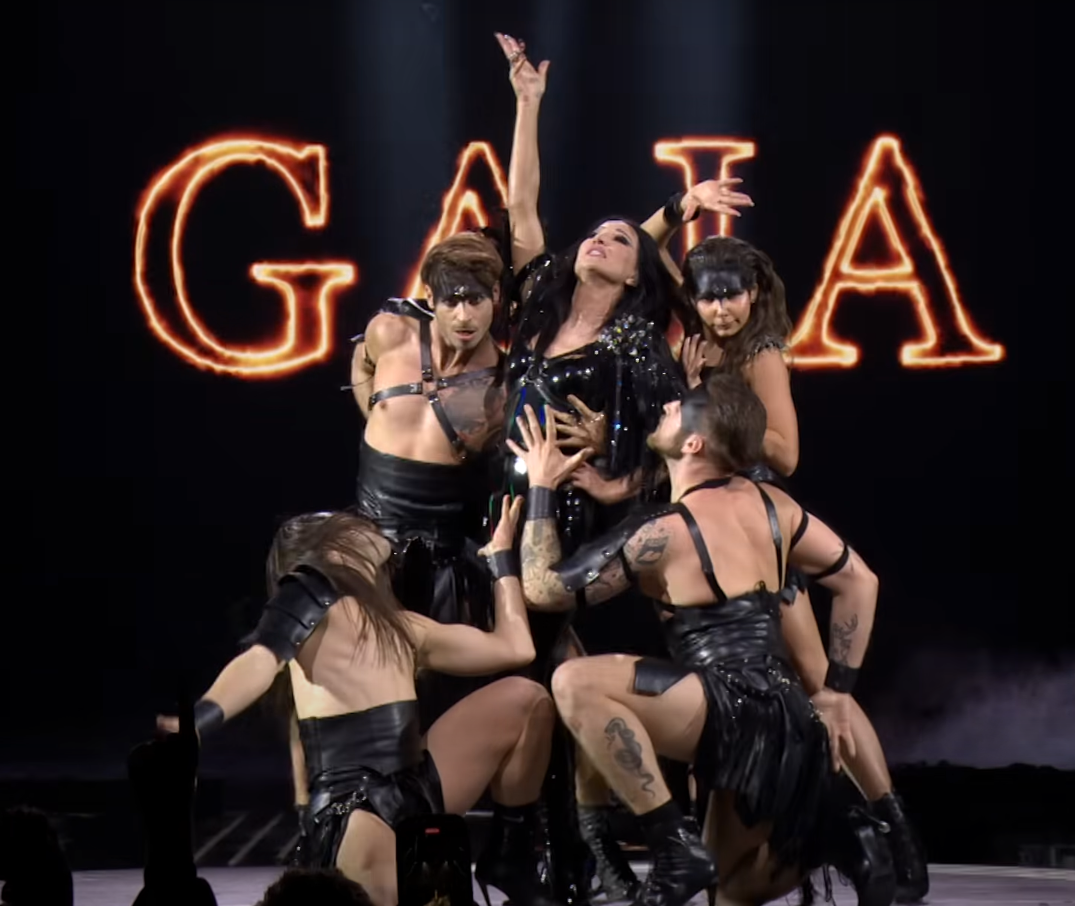
In 2025, Poland is once again sending Justyna Steczkowska to Eurovision. She’s now 52 years old, and is bringing a song called Gaja, about Mother Earth. Like 30 years ago, Justyna impresses with her ability to hold sustained notes….
…but this time, instead of holding those notes while swaying gently on stage, she’s singing while running through an entire Zumba class while dressed in latex and stilettos.
This performance is jam-packed: Justyna holds a note for a jury-impressing length of time! Justyna plays violin for five seconds to remind us that she can! Justyna wears an outfit made of nothing but plastic near continuous fireballs and does not reveal a single bead of perspiration! Justyna hangs from the ceiling because someone thought it would look cool (and it sort of does but not really enough to justify her just hanging there.) Justyna does burpees 2:40 seconds into the performance without sounding winded at all! (Maybe they’re not burpees. I’m not an athlete. I’m blogging in my pajamas.)
Eurovision has evolved since 1995 – in my opinion, for the better. I think that the staging concepts we see today make the show more entertaining both for the live audiences and those tuning in on the Saturday evening. It means that what people see at Eurovision is, even within the constraints of the rules, something that is akin to what would be viewed at a show like the Grammys or the VMAs.
Part of the difference between Justyna’s 1995 performance and her 2025 performance can be attributed to this evolution. Part of it can be attributed to the trends in Polish staging, which, since 2022, have veered toward the maximalist.
But at what point do we need to say: Maybe women in Eurovision are just feeling pressure to do more than their male counterparts?
I blogged about this earlier in the season when I talked about the difference in staging between two leading Festival i Kenges contenders, neither of whom ended up winning the performance. But since that point, we’ve seen a trend of women competing in National Finals and stuffing their performances with elements to the point where they are called “messy” and “chaotic.”
Take, for example, the Benidorm Fest performance of Esa Diva by Melody:
It is a performance that includes:
- one (1) giant hat
- two (2) flips from her dancers
- a gynecological shoulder hold
- a dance break
- a costume reveal
- three different stage areas (the swing, the floor, the crown)
- a sustained note bellowed from a squatting position
- pyrotechnics
- and, in what is the most outre element of the performance, an ad hoc ponytail propeller
Something in this performance changes about every 20 seconds, as if Melody is worried her song that celebrates women won’t be enough on its own to hold our attention without all of these tricks.
The same thing happened with the launch of France’s song Maman by Louane. Maman is a deeply touching ballad Louane has written directly to her mother, who died when she was still a teenager. In it, Louane talks about how the passage of time has lessened the grief she once felt, and how the term Maman is now one she associates with the joy of her own baby daughter, rather than the pain of her mother’s loss. It’s an incredible tearjerker of a ballad, and this is how France launched it:
Yup. With a full marching band, suspended in mid-air in the middle of a huge stadium, with pyrotechnics exploding beneath her platform. Oh, and this happened during the halftime of a RUGBY match.
I get that France is proud of their song, but this is more ridiculous than getting Carol Channing to do the Super Bowl halftime show. It’s a setting that is totally mismatched with the mood of the song. Louane doesn’t get an Eiffel Tower showcase like Tom Leeb, or a lovingly photographed placement on the New Year’s Special, with the Champs d’Elysee in the background. She’s got to perform while on a tiny platform staring at the turf of a stadium that’s fifty feet below her in front of an audience that is likely to be wholly unreceptive because they have come for the rugby match, not a heartfelt chanson.
Now, I know that a lot of you will be pointing out songs by men this year with unnecessary dance breaks and elaborate costumes and that’s not what I’m talking about here. I’m talking about the assumption that we will get so bored while a woman is performing that element after element needs to be layered on. Look at the chaos in Malta’s Serving, a song that doesn’t even rely on its staging as its main gimmick. Look at the after-effects poured onto Tautumeitas’ Bur Main Laimi, a song that shines due to its harmonies.
I want to end by highlighting one of the most watched performances by a man this Eurovision season – Mans Zelmerlow’s Revolution. (And please note, we’re just looking at this from a staging perspective, rather than anything else regarding the merits of the song or the controversies surrounding the person.)
There’s a lot going on in this staging – dramatic visuals, confetti flying around – but very little of it is Mans. Rather, the bulk of the work is done by the director and the camera operators. Mans gets to concentrate on singing and occassionally pumping his fist as choreography. The biggest thing he’s dealing with is trying to avoid not swallowing a rogue piece of confetti swirling around in the wind, but that’s something that Sissal was also fighting as her hair was blowing about in the much, much lower-budget staging for Hallucination.
You can point to this staging and note that ultimately, Mans wasn’t successful in his quest to return to Eurovision, but the staging is not what lost it for him. The viral success of Bara Bada Bastu is what won Melodifestivalen. And what strikes me is how much juice he got from a performance where he got to be on stage in comfortable shoes, whereas many of the women in Eurovision 2025 are contorting themselves into literal knots to try and get attention for their songs.
Of course, this dynamic can be said to be a reflection of the larger world, where women must do extra things which aren’t in the job description to get along in the workplace, even though these won’t help them advance on the career ladder. A world where women who accomplish a lot in the workplace are still judged more harshly than their male peers. A world where a 52-year old woman is expected to don a vinyl catsuit and stilettos to give off the right air of sexiness in a song competition, despite having a multi-octave vocal range and violin skills.
I don’t care if you think I’m overreacting to what I’ve observed. All I know is that I would like to give Justyna Steczkowska a chance to sit down for a minute. Goodness knows she’s earned it.
 dudepoints.fun